Dynamic Shopping Ads for 2A: Turn Your Product Catalog Into a Performance Engine

Feb 4, 2026

Armanet Dynamic Shopping Ads pull your live inventory, auto-build compliant ads, and optimize product promotion across 200+ 2A publishers—driving measurable ecommerce revenue.

Dynamic Shopping Ads for 2A: Turn Your Product Catalog Into a Performance Engine

Every other e-commerce category runs dynamic product ads. The 2A industry hasn’t been able to — until now. Here’s what Armanet Dynamic Shopping Ads actually do and why they matter.

If you’ve ever shopped for anything online — shoes, electronics, furniture, literally anything — you’ve seen dynamic shopping ads. You search for a product, and then for the next two weeks, that exact product follows you around the internet. The image, the price, and a “Shop Now” button. Sometimes it’s a carousel showing you the thing you looked at, plus three similar items. It’s so common that most people don’t even think about it anymore. It’s just how e-commerce advertising works.

Except in the firearms industry, where it basically doesn’t exist.

Google Shopping won’t run firearms products. Meta won’t. The major demand-side platforms that power dynamic product ads for every other retail category have policies that restrict or ban guns, ammo, optics, suppressors, and most accessories. So while a shoe company can upload its product feed and have Google automatically generate and optimize ads for every SKU in its catalog across the entire internet, a firearms brand has to design a static banner manually for one product, traffic it to one publisher, hope it works, and then do it again next month for a different product. If you’re a retailer in the firearms space, this is a crazy limitation on how you market your products compared to the Walmarts of the world.

The absurdity of this really hits you when you think about it at scale. A brand like Cabela’s or Brownells has thousands of SKUs. Pricing changes constantly. Inventory fluctuates. New products launch. Seasonal demand shifts. And the only way they’ve been able to advertise digitally is by manually creating static display ads for a tiny fraction of their catalog and placing them one publisher at a time. Wildly suboptimal.

This is the problem we built Dynamic Shopping Ads to solve.

What Dynamic Shopping Ads Actually Do

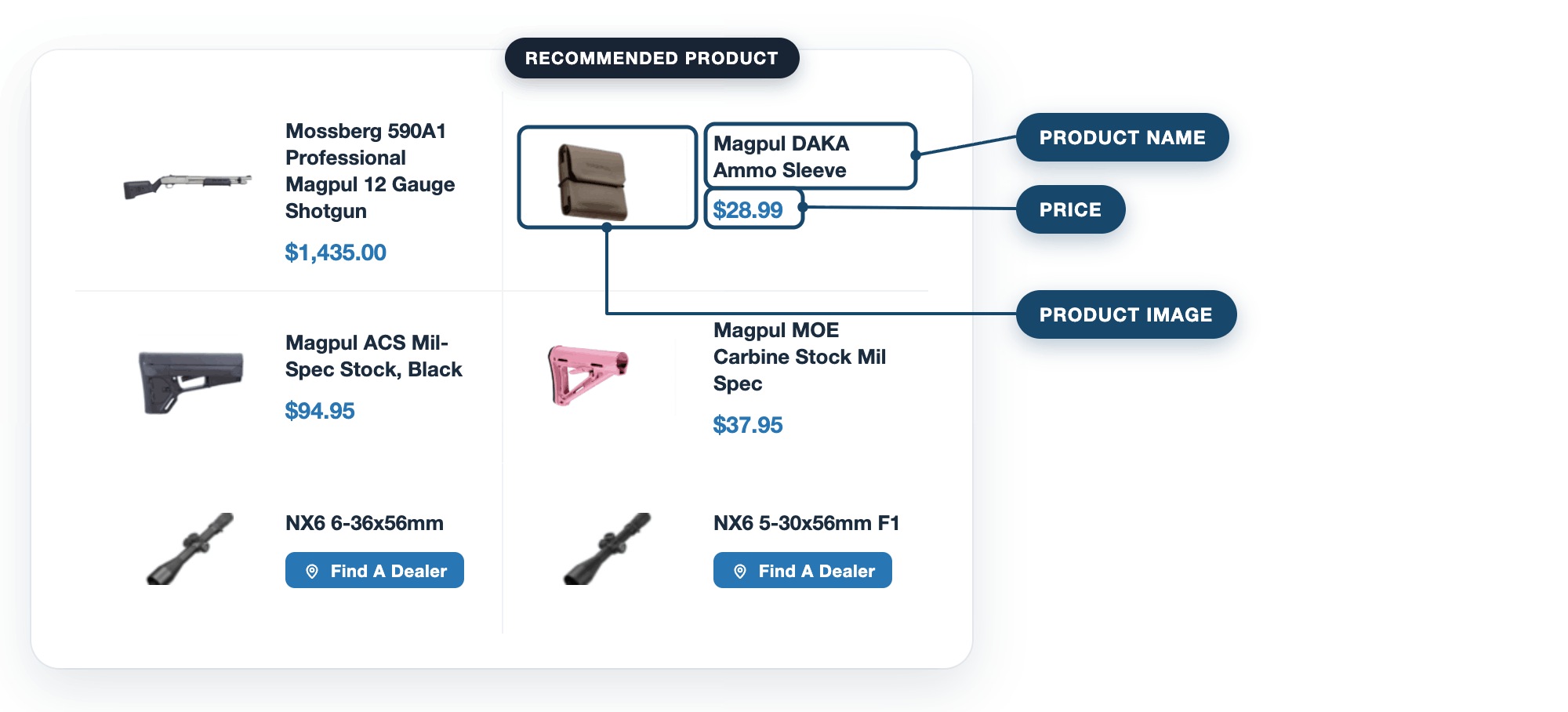
The concept is simple, and it’s the same concept that powers billions of dollars in e-commerce advertising across every other category. You connect your product feed to Armanet. That feed contains your live inventory — titles, images, pricing, availability, URLs. The platform automatically generates ad units from that feed. When your pricing changes, the ads update. When a product goes out of stock, it stops being promoted. When a new SKU goes live, it gets added. No manual creative swaps, no email chains to your ad ops person, no uploading new banners every time something changes.

But here’s where it gets really interesting for firearms brands specifically. Armanet doesn’t just display your products randomly. We use first-party data from across our network — behavioral signals, purchase propensity, contextual alignment, and what’s performing across the ecosystem — to determine which products to show to which buyers. So if someone has been researching red dot sights across multiple 2A publishers and you sell red dot sights, they see your specific products at your current pricing with real-time availability. Very different from a static banner. That’s a targeted, dynamic, performance-optimized product ad that’s doing exactly what Google Shopping does for every other industry.

And these ads run across our full network of 200+ endemic publishers. Firearms sites, outdoor sites, hunting sites, tactical sites, conservative media. High-intent audiences who are actively in-market for the types of products you sell. No policy restrictions to worry about. No feed disapprovals because someone at Google decided your product category was too “dangerous.”

Why This Is a Bigger Deal Than It Sounds

I want to take a step back and explain why dynamic shopping ads matter so much, because if you’ve only ever done static display in this industry, the difference might not be immediately obvious.

Static display is a blunt instrument. You design a banner promoting (usually) one product or a brand message. You place it on a site. Everyone who visits that site sees the same ad regardless of what they’re interested in, what they’ve been shopping for, or where they are in the purchase journey. It’s the equivalent of putting up a billboard. Some people who see it might be interested, but most aren’t, and you have no way of knowing which is which. Don’t get me wrong — well-made static banner ads have their place — but it’s usually more for awareness or specific promotional messaging versus a retailer’s direct response performance engine.

Dynamic shopping ads are a precision instrument. Instead of showing everyone the same generic banner, you’re showing each person the specific products they’re most likely to buy, at the current price, with current availability. If someone’s been browsing AR-15 accessories, they see AR-15 accessories from your catalog. If someone’s been looking at optics, they see your optics. The ad is built dynamically for each impression based on what we know about that user’s behavior and intent.

The performance difference between these two approaches is massive. It’s the difference between hoping someone who sees your ad happens to want what you’re selling and knowing they do because you can see their research behavior. Dynamic shopping ads have higher click-through rates, higher conversion rates, and dramatically better ROAS than static display. Every major e-commerce brand outside of firearms has known this for years. The 2A industry just hasn’t had access to it.

Until now., and honestly, this is one of the features I’m most excited about on the platform. It’s genuinely going to change how firearms e-commerce works.

What You Actually Have to Do (Not Much)

This is the part that makes marketing managers’ eyes light up. Connect your product feed to Armanet. Work with your account manager to approve the template and set your strategy — full catalog, specific categories, high-margin products, seasonal pushes, whatever makes sense for your business. That’s it.

From there, the platform handles everything. Ad units are generated automatically from your feed. Creative updates happen in real time as your catalog changes. Optimization runs continuously based on performance data. You don’t need to design banners. You don’t need to traffic campaigns to individual publishers. You don’t need to send updated creative every time a price changes or a product goes out of stock. The feed powers the engine, and the engine runs.

If you’re on Shopify, BigCommerce, WooCommerce, or Magento, we have plugins that make the feed integration even easier — clean purchase tracking, product feed ingestion, and the whole dynamic ads setup with minimal lift from your team.

For brands that have been spending hours each month on manual creative swaps and publisher-by-publisher trafficking, this is a ridiculous amount of time and operational overhead that just disappears.

You Can See Exactly What’s Selling

Every Dynamic Shopping campaign comes with real-time reporting at the SKU level. You can see which specific products are getting impressions, clicks, and conversions. You can see which products have the best ROAS. You can see which publishers are driving the most revenue for which product categories. And you can use all of that data to make smarter decisions — scale budget toward top performers, promote different products seasonally, and understand what your customers actually respond to at a level of granularity that static display has never been able to provide.

This kind of product-level performance data doesn’t just help your advertising. It helps your entire business. When you can see that a specific SKU is converting at three times the rate of everything else in its category, that’s intelligence that your product team, your merchandising team, and your retail partners all benefit from. Advertising becomes a source of insight, not just a line item on your P&L.

And of course, this all ties into the broader Armanet dashboard. Dynamic Shopping Ads run alongside your display, video, and CTV campaigns as part of one cohesive omni-channel buy. You see everything in one place, track together, and optimize together.

Bottom Line

Dynamic shopping ads are the backbone of modern e-commerce advertising. Every major retail category has been using them for years to drive measurable, scalable revenue. The firearms industry has been locked out of that capability entirely — forced to rely on static banners and manual processes while competitors in every other category run automated, data-driven product promotion.

Armanet Dynamic Shopping Ads brings that same infrastructure to 2A brands. Your live catalog is automatically turned into optimized product ads running across 200+ endemic publishers, with SKU-level reporting and real-time optimization. Less work for your team, more revenue from your products, and actual data showing you what’s driving it.

Your product catalog should be your best-performing advertising asset. Now it can be.

Schedule A Demo Now

Related Articles

All posts
Top