

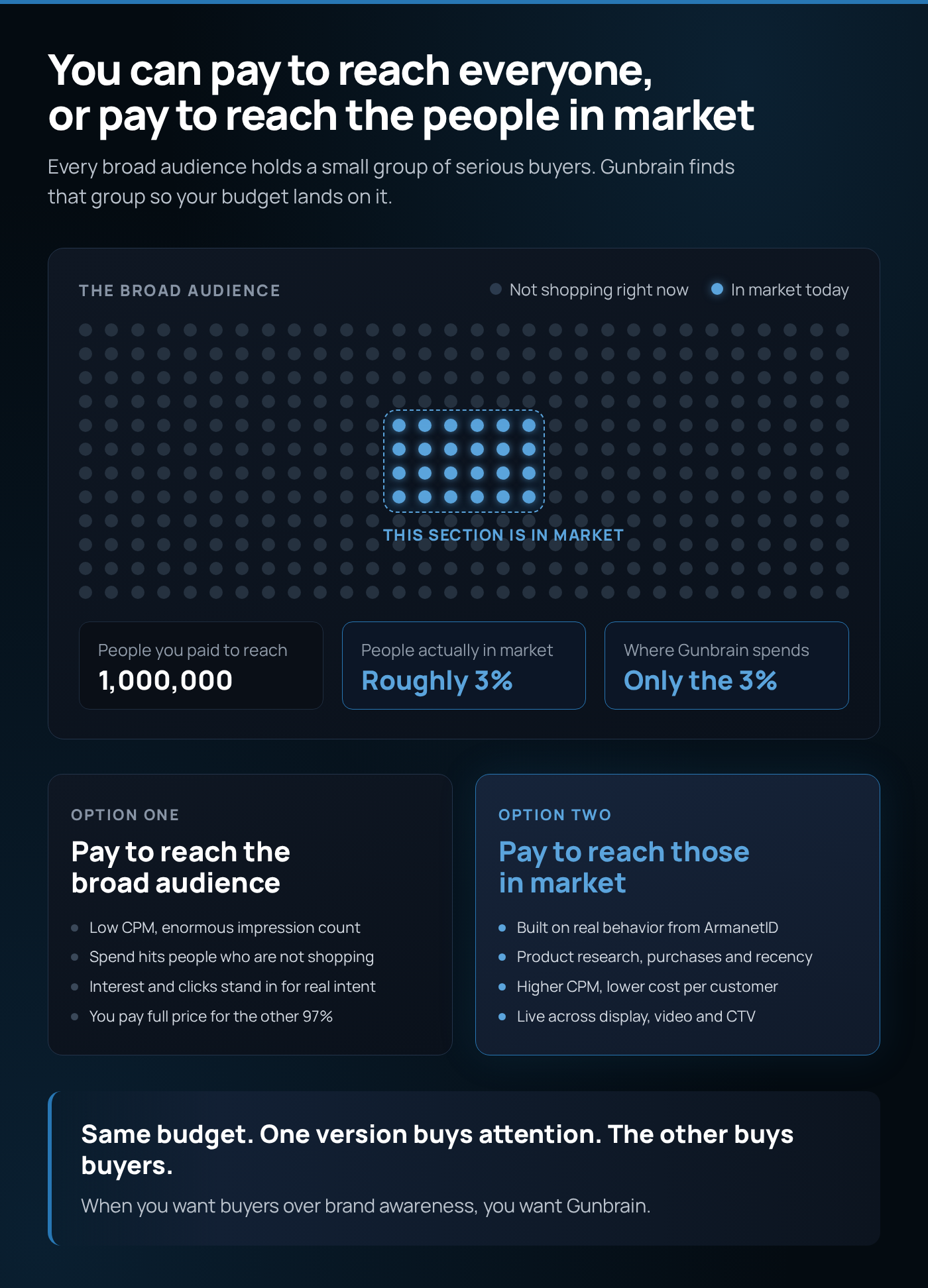
Here is a decision every media buyer in this industry makes without quite saying it out loud. You have a budget and a product to sell, and you can spend that money one of two ways: reach a lot of people cheaply, or reach fewer people precisely. The cheap route seems like the best route on the way in. The CPM is low, the impression count is enormous, the end-of-campaign report is a wall of big green numbers. But impressions were never the thing you were after, customers were. And a rock-bottom CPM against the wrong hundred thousand people is just a very efficient way to set money on fire.
Sometimes the big cheap number is the right call. If you are launching a rifle and you need the entire category to know it exists by Friday, reach is the job, so go make noise and do not apologize for it. But that is not most campaigns. Most of your budget lives in the direct-response work that has to actually move product this quarter, and there, precision is the lever that moves the number. That is the campaign Gunbrain Audience Targeting was built for.
Endemic Is Your Floor, Not Your Ceiling
Buying broad placements across 2A sites already does half the work for you, and that is exactly why it has been the industry default for years. Everyone on an endemic site is into guns, so you are at least in the right building. We make the full case for why "in the right building" stops being good enough in our Meet Gunbrain post, so I will not re-litigate it here. The short version: a firearms consumer in the broad sense is not the same as a buyer for your specific product this week, and broad reach cannot tell the two apart. It charges you full freight to talk to both.
Which lands you on the only question that actually matters for a performance campaign: of the impressions you are paying for, how many are qualified, and can you buy more of the ones that are? That comes down to two things. The data underneath the targeting, and the math of what a qualified impression is worth. Take them in order.
Your Targeting Is Only As Good As The Data Under It
The reason most audiences disappoint is that they are built on guesses dressed up as signals. Someone did a singular thing (like click on a link) and then landed in a bucket because that link has guesses around intent attached to it. It feels like data, but none of it tells you with a high degree of confidence that a single one of those people is about to buy an optic.
Gunbrain builds audiences from what people actually did: product research, category browsing, purchase history, and how recently any of it happened. It runs on ArmanetID, our anonymous, verified identity layer, so the signal is real behavior pulled from inside the network rather than modeled interest rented off the open web. No names, no personal information, just behavior in and audience intelligence out. If you want the full story on how that identity graph gets built, we cover it in our Meet Gunbrain post. For a buyer, the part that matters is short: everyone in a Gunbrain audience did something that says they are in the market.
The "Why Pay More For Fewer" Question, Answered With Math
It is the first thing every advertiser asks, so let's walk through the math:
Say you sell pistol red dots. You buy a broad endemic run, a million impressions at a cheap CPM of $3-5, and maybe 3% of the people who see it recently bought a handgun and are actually shopping optics for it. You paid for a million. Thirty thousand of them mattered. The rest was overhead you will never get back. Now take that same spend and point it at a Gunbrain audience of recent handgun purchasers who are researching red dots this week. Fewer impressions, much higher CPM ($8-10), but almost every dollar lands on someone who could actually buy the thing you sell. The sticker price per impression went up but the cost per action / acquisition of a new customer went down.
That's pretty much the whole idea. To move from a paradigm of cheap impressions to targeted / precise impressions that reduce waste and make your ad dollars go further. A smaller audience built on real intent beats a huge one built on weak signals almost every time.
Build It Once, Run It Everywhere
Once you have the right audience, using it is the easy part. Gunbrain audiences activate across display, video, and connected TV inside Armanet, so you are not rebuilding your targeting every time you change formats. You can slice by category (optics, pistols, ammunition, suppressors, hunting gear, accessories), by how recently someone was in-market, and by what they have already bought, then layer those together to get as specific as the campaign needs. The recent-handgun-buyer shopping red dots. The AR owner who keeps pricing suppressors. The elk hunter gearing up in August. Build the audience around what they did, and let the rest of the internet go bother someone else.
The Takeaway
Before your next campaign, get honest about what the money is actually for. If the job is noise, buy reach and make it loud. If the job is revenue, stop renting a million strangers and start bombarding the few thousand people who are already reaching for their wallet. Gunbrain Audience Targeting is how you do the second one properly. Contact your Armanet team and we will build the audience for your next campaign.