
.png)
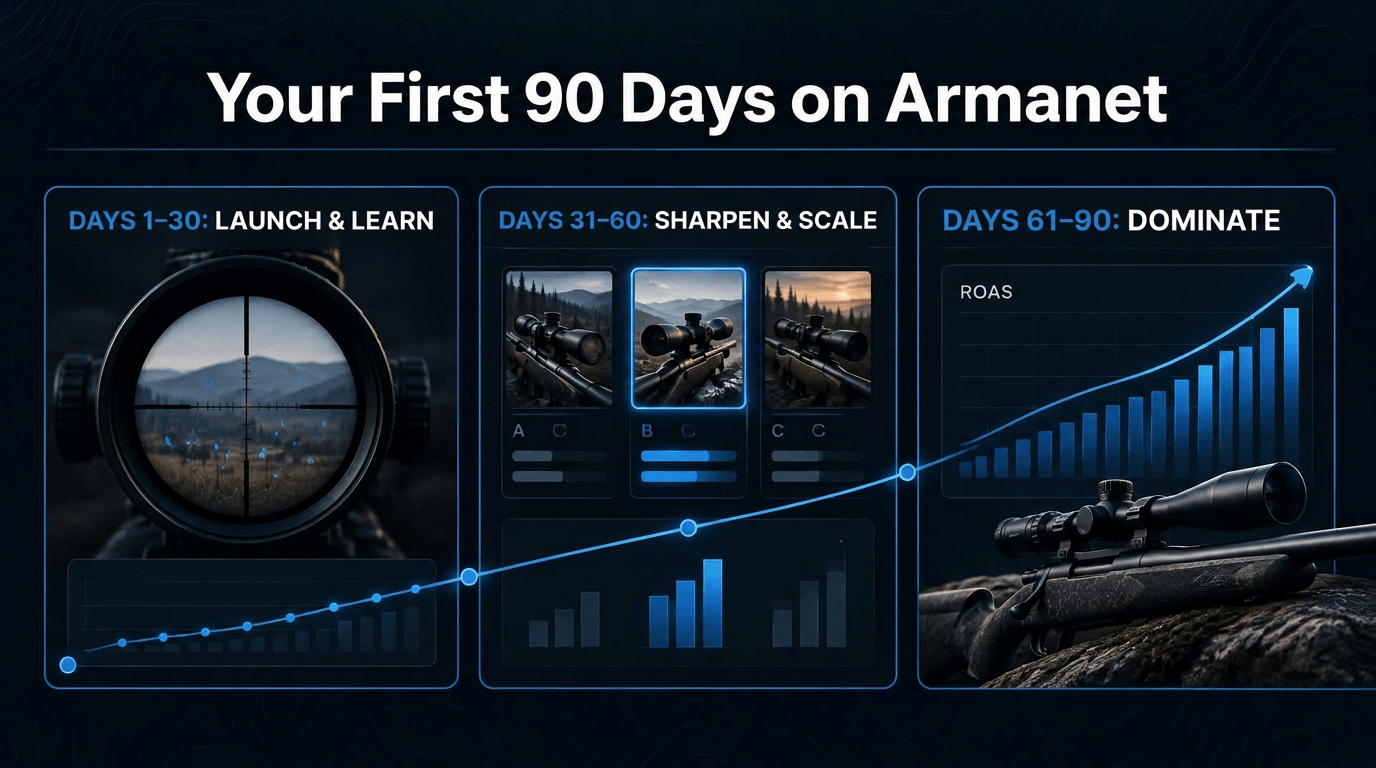
It's day 30. You log into your Armanet dashboard, check your ROAS, and wonder whether your campaign is delivering the results you expected. It's a fair question, especially when every advertising dollar needs to prove its value. But there's something important to understand about programmatic advertising: performance isn't always immediate, and the first 30 days rarely tell the whole story.
At Armanet, we don't lock advertisers into long-term contracts. You continue advertising because you're seeing value, not because you're obligated to. But we also want advertisers to understand how campaigns develop, why early performance can be misleading, and what it takes to build sustainable results.
Think of your first 90 days in three phases: Learn, Optimize, and Perform. These aren't rigid deadlines, and they aren't a sequence where optimization waits its turn. Optimization begins the moment your campaign launches and continues throughout the first 90 days. What changes is how much data we have to work with, and how confident we can be in the decisions we make with it.
The results you see at day 90 are shaped by what happens before launch. Setting realistic goals and a starting budget upfront gives your campaign the best foundation to build on.
Before You Launch, Define What Success Looks Like
Not every campaign is designed to accomplish the same thing, and ROAS isn't always the right measurement of success. Establishing realistic goals upfront, and agreeing on what a good result looks like at 30, 60, and 90 days, makes it far easier to judge performance fairly and make confident decisions along the way.
If your goal is brand awareness, reach, frequency, and impressions help you understand how effectively you're introducing your brand to potential customers. If you're focused on driving traffic, clicks, CTR, and CPC become more relevant. For direct-response campaigns, conversions, cost per acquisition, attributed revenue, and ROAS help measure purchasing outcomes. Retargeting campaigns may place greater emphasis on conversion rates and bringing interested shoppers back to purchase.
Each metric tells a different part of the story, and judging every campaign by immediate revenue can overlook the value it's building elsewhere in the customer journey.
We've covered this in more detail in How to Choose the Right Campaign Goals, KPIs, and Benchmarks Before You Launch.
Equally important is installing the Armanet SDK. It connects your website activity to campaign reporting, giving you visibility into purchases, revenue, view-through and click-through conversions, time to conversion, and product-level performance.
The more accurately we can measure what's happening, the better equipped we are to identify opportunities and optimize your campaigns.
Days 1–30: Learn
Your campaign begins reaching relevant audiences across Armanet's network of more than 200 endemic publishers, including conservative media inventory.
During this period, we're identifying which publishers, audiences, products, and creative assets are generating engagement. Some combinations will perform better than others, but early results need context.
A campaign generating a strong click-through rate in its first week may be showing encouraging signs even if purchases haven't followed yet. With display advertising CTRs sometimes around 0.1%, clicks represent only one part of how advertising influences purchasing decisions.
That's why we also look at CPC, early conversions, traffic quality, and view-through activity rather than judging the entire campaign by immediate ROAS.
Optimization doesn't wait for day 31. From launch, we're monitoring performance and making adjustments as the data allows, even if the early data is still limited.
The first month is about identifying signals, not expecting every campaign to have already reached its full potential.
Days 31–60: Optimize
The optimization that began at launch gets sharper here. As data accumulates, we can make more informed decisions about where your budget is working hardest.
This is where publisher-level optimization, audience refinements, and creative testing become especially valuable. Underperforming placements can be reduced while more budget is directed toward combinations demonstrating stronger results.
Creative plays an important role here. Give us multiple ads with different imagery, messaging, or offers, and we can evaluate which resonate with your audience. You don't need dozens of variations, but you do need creative that communicates value and gives customers a reason to engage. For practical guidance, read How to Build Display Ads That Actually Convert in the 2A Industry.
Your role is equally important. Keep your account manager informed about upcoming promotions, changes in business priorities, and new creative assets. The more closely we collaborate, the more effectively we can adapt your campaigns.
Optimization isn't a one-time event. It's an ongoing process of learning what works and improving what doesn't.
Days 61–90: Perform
By this point, campaigns with sufficient activity have had more opportunity to establish performance patterns, identify effective placements, and build a clearer picture of return on investment.
This is when you can begin making more confident decisions about scaling successful tactics, expanding into additional formats, or refining your overall advertising strategy.
But day 90 isn't a finish line, and it isn't a guarantee that every campaign will reach a particular ROAS. Performance depends on your budget, products, creative, website experience, and the amount of data available.
The real advantage of continued advertising is the opportunity to keep learning, improving, and building on what works.
The Longer You Advertise, The More Opportunities You Unlock
Consistent advertising creates value beyond individual campaign results. As more data becomes available, Armanet can help advertisers take advantage of additional capabilities:
- Retargeting: Build an audience of interested shoppers and bring them back when they're ready to purchase.
- Smarter Audience Targeting: Use purchase events and behavioral signals to refine who sees your advertising.
- Retail Halo Reporting: Gain visibility into attributed purchases through participating retail partners, helping connect advertising activity with sales beyond your own website.
- Armaview Incrementality: Understand how much additional revenue your advertising generates by comparing exposed audiences with a holdout group. Reliable measurement requires sufficient campaign volume and time.
- Additional Advertising Channels: Expand into Publisher Email, Creator Sponsorships, CTV, and other Armanet offerings as your strategy develops.
These capabilities aren't necessarily restricted to advertisers who have completed 90 days. Their usefulness and measurement reliability depend on your campaign setup, available data, and eligibility.
Your Budget Influences How Quickly You Learn
One of the most important decisions you'll make before launch is your starting budget. It's also one of the most important factors in campaign optimization, because it determines the amount of data available.
A campaign spending $1,000 per month will generally accumulate impressions, clicks, and conversions more slowly than one spending $1,000 per day. That means it can take longer to identify meaningful performance trends and make confident optimization decisions.
We've seen this firsthand. One advertiser starting near $1,000 per month exceeded CTR benchmarks in its first week but hadn't yet generated conversions. Another, spending more than $1,000 per day, saw reported ROAS increase from approximately 3x to 6x within its first week.
Those examples aren't performance guarantees, and the difference can't be attributed to budget alone. They illustrate how campaign volume can affect the speed at which meaningful results become visible.
A larger budget can accelerate learning. It doesn't automatically guarantee better performance.
For advertisers starting with smaller budgets, we recommend focusing on fewer campaign tactics, maintaining consistent spend, and allowing enough time to collect meaningful data. Starting with a few thousand dollars per month, when feasible, can provide more opportunity to evaluate performance sooner.
Your First 90 Days: A Quick Checklist
Before launching your next campaign, make sure you've established the fundamentals:
- Define your primary advertising goal and KPI, and make sure your expectations for 30, 60, and 90 days are realistic.
- Set a starting budget that aligns with your goals and evaluation timeline.
- Install and verify the Armanet SDK.
- Provide multiple creative assets for testing.
- Remember that optimization starts at launch, so stay in touch from day one.
- Allow sufficient time and data before making major performance judgments.
- Schedule regular check-ins with your Armanet account manager.
The most successful advertising strategies aren't built around constantly starting and stopping campaigns. They're built around clear goals, reliable measurement, consistent execution, and a willingness to optimize.
Armanet gives you the technology, inventory, and reporting to support that process. Your budget, creative, website experience, and ongoing collaboration all contribute to the outcome.
Ready to build a campaign designed for long-term success? Talk with our team about your goals, starting budget, and what realistic performance expectations look like for your business. We'll start optimizing from day one.